In August 2019, doctors in my hometown of Searcy, Arkansas, diagnosed me with Stage IV gastric cancer. My local oncologist said he would treat me if I wished, but that my advanced disease would likely be better addressed in a research hospital. I followed that advice and, within two months of my initial diagnosis, I tested positive for the HER2 biomarker and started a clinical trial testing a drug called ZW25 at MD Anderson Cancer Center. My treatment options were very limited otherwise, and I am grateful that I am thriving as a result of an experimental drug I received only because of my biomarker status.
Diagnosis and Early Treatment
I was 56 years old at the time of my diagnosis, with a busy life working in the school system, caring for aging parents, and enjoying our grown kids and close friends. I had noticed some symptoms such as a knot in my back, difficulty swallowing and occasional vomiting as a result of my inability to swallow. I ignored those signs until I experienced what felt like a punch between my shoulders on a morning walk with my husband.
Later that day, I mentioned it to the nurse in the elementary school where I worked, and she recommended I call my doctor.
I am not a big internet searcher of medical issues, but suspected that, given my age and a diet that included spicy food and alcohol, it might be an easily-resolved gallbladder issue. Stomach cancer was not even on my radar.
I got in with my local doctor’s office quickly, where I underwent a gallbladder ultrasound along with some blood tests. On the drive home from that appointment, the nurse practitioner called in tears to tell me to come back, and not to come by myself.
My diagnosis was Stage IV cancer in the GI junction of the esophagus and stomach, which had spread to the lung, liver and lymph nodes. My oncologist said there wasn’t anything very promising they could do for me locally, and that if he were in my shoes he’d go to MD Anderson and see if there were any clinical trials available to me.
Thank the Lord I did that because, after testing positive for the HER2 biomarker, I qualified for a clinical trial testing a drug called ZW25. ZW25 is an antibody-drug conjugate that inhibits cancer growth by targeting and destroying the excess HER2 proteins in my cancer which themselves promote cancer growth. I started the trial in October 2019 and have been participating for more than four years now.
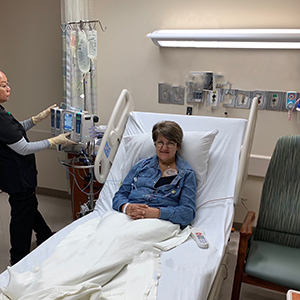
At the beginning of the trial, I also did nine or ten rounds of chemotherapy just before and at the start of the COVID pandemic. I was very sick as a result of the chemo, but had no surgeries or hospitalizations. While quarantine made cancer treatment that much more challenging, I try not to dwell on the negative too much and focus on the positive. I still go to Houston every other week from Wednesday through Friday for my treatment. Though it’s an eight-hour drive from my home, the wonderful people with AngelFlight usually fly me there. I am so fortunate in so many ways!
The Case for Biomarker Testing
If I had not tested positive for HER2, my only treatment option would have been chemotherapy. Because I did have biomarker testing and tested positive, I was able to participate in this clinical trial, my cancer is stable and my prognosis is simply to continue my life. While I will have the biweekly treatments indefinitely, I am happy to do them if I can feel this good!
My life today is pretty normal, and still busy. Though I was able to stop working so I can travel to Houston for treatments, we have a three-year-old granddaughter, our kids live within easy driving distance and my husband and I enjoy seeing and supporting our aging parents. I’m so grateful we’ve been afforded the time to fully live this season of life.
Because my cancer was so advanced, this clinical trial was the best shot I had to stabilize my cancer. While I’ll always hope for a miracle cure, the reality right now is that we can’t get rid of stomach cancer altogether, so it’s critical that we find new drugs that will help us live longer and more productively with it. Of course, not every clinical trial works for everyone but, even if it hadn’t worked for me, I liked the idea that it might work for someone else.
I would not have had access to what has been a life-enhancing–perhaps even life-saving–drug if I hadn’t tested for biomarkers and discovered I am HER2+. I would encourage any newly-diagnosed stomach cancer patient to ask about biomarker testing, and to take a long, hard look at the clinical trials available to them. If there is something they can participate in, I would say to them, “Why NOT?”