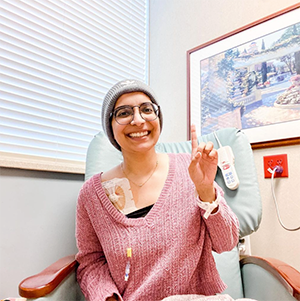
After years of misdiagnoses and ineffective medical and surgical treatments, I was finally correctly diagnosed with Stage 4 stomach cancer in 2020 when I was 27 years old. At the time, doctors gave me a 32 percent chance of living five more years, and I remember thinking, “I have a 32 percent chance of seeing my 32nd birthday.” It was another few years before I found a healthcare team that insisted I undergo stomach cancer biomarker testing which revealed that my cancer was considered MSI-high, and a good candidate for targeted treatment. Today, nearly five years down a winding and often frustrating treatment path, that targeted treatment has improved my quality life, and likely given me years I may not have had otherwise. At 31, survival doesn’t seem so out of reach.
Diagnosis and Early Treatment
My struggles with stomach problems and gastrointestinal issues started when I was in high school, and a gastroenterologist began treating me for ulcers in my late teens. Though I had several clear CT scans, and numerous endoscopies that never detected any cancer, I knew something was very wrong as my health deteriorated and I had increasing pain, nausea and fatigue that often landed me in the ER.
Eventually, I was misdiagnosed with duodenal cancer, and I underwent a Whipple procedure to remove tumors. That surgery revealed that I actually had metastatic stomach cancer with aggressive pancreatic involvement. Post surgery, I underwent FOLFOX chemotherapy, a grueling experience that caused me to have seizures and lose consciousness. It was unsustainable, so I spoke to my oncologist about immunotherapy, who said it was a last resort that wouldn’t help me.
Unconvinced, I sought a second opinion at MD Anderson, where my health care team tested me for biomarkers in a simple, noninvasive process involving blood draws and a saliva test. The doctors explained the results showed I was MSI-high, which meant my cancer cells had mutated and disguised themselves, which made the chemo I was on completely ineffective at treating my particular disease.
However, they said I was a good candidate for pembrolizumab (Keytruda), and I was ecstatic to have something different and more targeted to try. My health insurer immediately denied my claim, however, and I was forced to go through a dehumanizing and scary months-long period during which I fought for coverage for the treatment my doctors knew was right for me. I could not afford the medication out of pocket, and I went without any treatment at all for several months. It was only because an advocacy organization called Hope for Stomach Cancer suggested I apply for Merck’s patient-assistance program that I ultimately received Keytruda through the manufacturer.
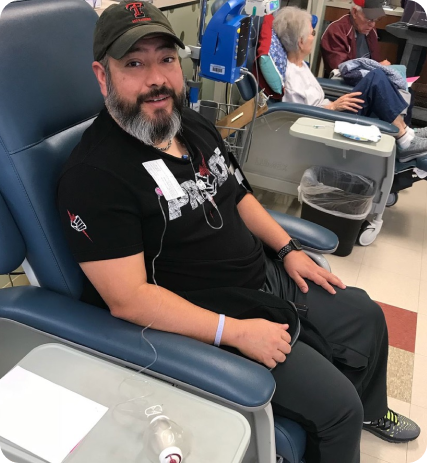
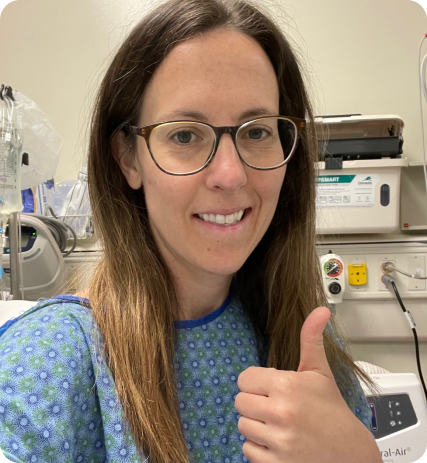
I was on Keytruda from March 2021 until May 2023. The side effects were minimal and my quality of life was worlds apart from when I was on chemo and could not even pick up a glass of water from my bedside table. I went back to work, and my scans were clear after six weeks. They are still clear today.
My struggles with stomach problems and gastrointestinal issues started when I was in high school...
The Case for Biomarker Testing
I am truly not sure where I’d be, or if I’d even be alive today, if I hadn’t had biomarker testing and received the right treatment for my cancer.
In hindsight, I wish I had known about stomach cancer biomarkers and undergone testing earlier because the information would have steered me towards a targeted, more effective treatment sooner.
I want all newly-diagnosed stomach cancer patients to know how important it is to prioritize early biomarker testing. Asking questions about PDL-1 scores, MSI status, HER2 and other specific biomarkers should be part of their dialogue with their healthcare team. In addition, engaging with the cancer community and patient-centered organizations can be invaluable.
Five years after my diagnosis, I am working full time as a realtor and enjoying my life. Although scans, bloodwork, and endoscopies remain part of my annual routine as I vigilantly monitor my health, I’ve mostly transitioned from receiving support to trying to provide it. At times, I have survivor's guilt because so many wonderful people I’ve met on this journey have passed away.
That sad fact underscores the urgency I feel that I must continue advocating for young adults facing stomach cancer. So many people mistakenly assume stomach cancer is an older person’s disease, and that a late stage diagnosis can’t be overcome. I am living proof that there is reason to hope, and that targeted treatment can benefit others in the same way.